
Prayer in Islam (Salat)
Discover the importance, times, and practice of prayer, a direct link between the believer and God, and one of the five fundamental pillars of Islam.
The importance of prayer
Prayer (Salat) is the second pillar of Islam and forms a direct link between the believer and God. It is obligatory five times a day at specific times and is an act of worship that purifies the soul and reminds the human being of their relationship with their Creator.
"Prayer is the pillar of religion. Whoever establishes it establishes their religion, and whoever abandons it abandons their religion."— Prophet Muhammad (peace and blessings be upon him)
More than a mere obligation, prayer sets the rhythm of the Muslim's day, allowing them to constantly remember God amid their daily occupations. It is a moment of contemplation and meditation that brings serenity and inner peace.
Useful tools for prayer
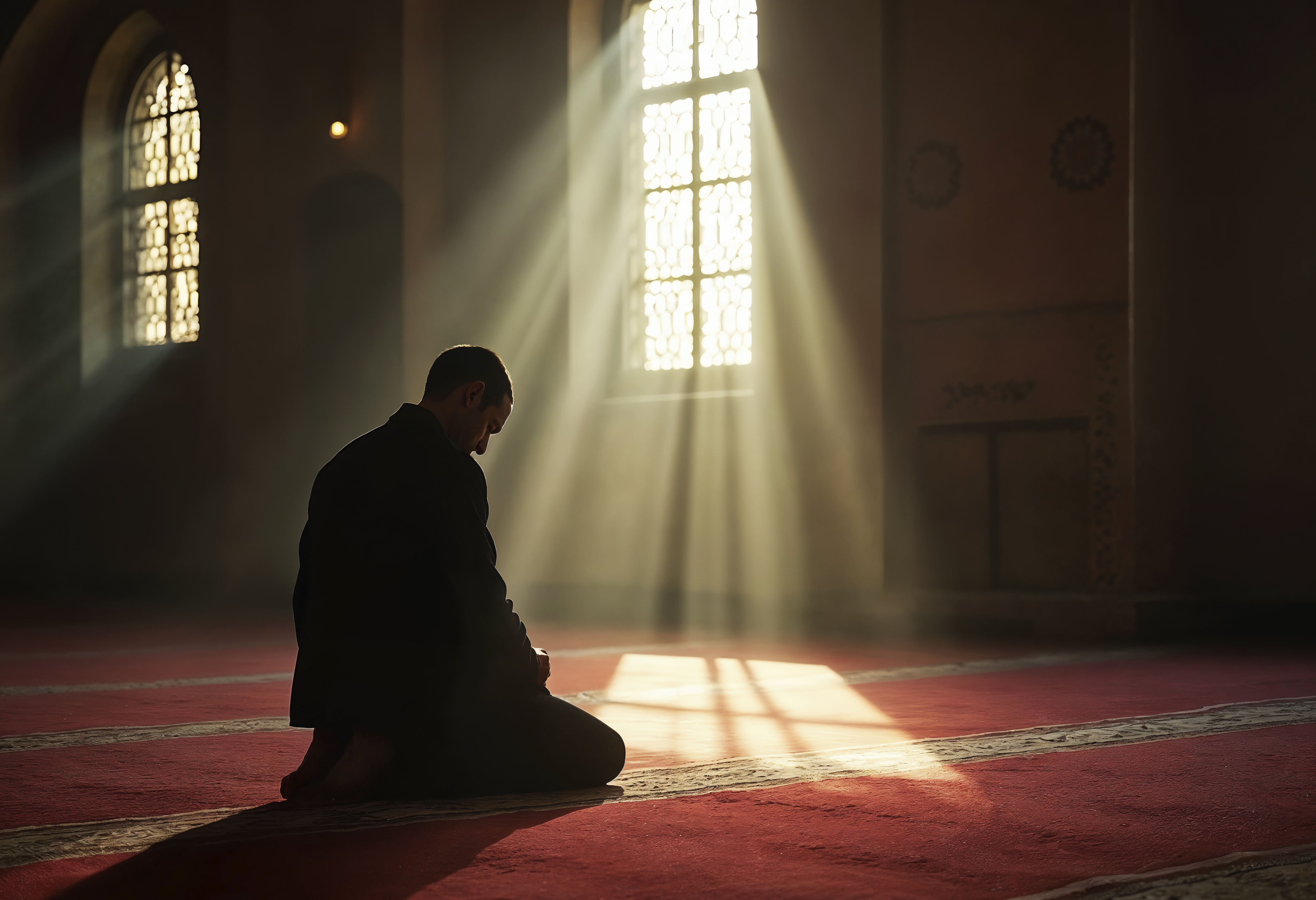
Prayer purifies the soul and elevates the spirit toward its Creator
The five daily prayers
The practicing Muslim performs five prayers a day, at specific times determined by the position of the sun. Each of these prayers has its own importance and particular meaning.
Fajr
Dawn
The dawn prayer, before sunrise.
Rakats: 2 obligatory rakat
Time: From dawn until sunrise
Dhuhr
Noon
The midday prayer, after the sun has passed its zenith.
Rakats: 4 obligatory rakat
Time: From noon until mid-afternoon
Asr
Afternoon
The afternoon prayer.
Rakats: 4 obligatory rakat
Time: From mid-afternoon until sunset
Maghrib
Sunset
The sunset prayer, just after the sun has disappeared below the horizon.
Rakats: 3 obligatory rakat
Time: From sunset until the twilight fades
Isha
Night
The night prayer, after daylight has completely disappeared.
Rakats: 4 obligatory rakat
Time: From night until dawn
The beauty of prayer
Prayer in Islam is a profound spiritual experience that combines bodily movements and sacred recitations.
Individual prayer
A moment of spiritual intimacy between the believer and their Creator, allowing for personal reflection and deep meditation.
Congregational prayer
Collective prayer unites the community and strengthens fraternal bonds, creating an atmosphere of solidarity and spiritual union.
Spiritual focus
Khushu' - the state of concentration and total submission during prayer that allows a deep connection with the divine.
Spiritual benefits
Discover the spiritual and mental benefits of regular prayer, and how it positively affects our daily well-being.
Meditation & prayer: video course
A series of video courses to deepen your knowledge of meditation in Islamic prayer and methods to reach deeper spiritual focus.
Interactive prayer guide
An interactive multimedia guide explaining each movement and invocation of prayer with 3D visualizations and audio recitations for complete, immersive learning.
How to perform the prayer?
Islamic prayer follows a precise set of movements and recitations. Here are the main steps to perform a prayer correctly.
Intention (Niyyah)
Before starting the prayer, the Muslim must form the intention to pray, specifying which prayer they will perform. The intention is formed in the heart, not verbally.
Opening Takbir
The prayer begins with the opening Takbir, saying "Allahu Akbar" (God is the greatest) while raising the hands to ear level.
Standing position (Qiyam)
The worshipper recites Surah Al-Fatiha (the opening of the Quran) and another surah or verses of the Quran, standing with hands placed on the chest.
Bowing (Ruku)
Saying "Allahu Akbar", the worshipper bows, hands on the knees, back horizontal, and glorifies God saying "Subhana Rabbiyal Adhim" (Glory to my Lord, the Most Great).
Prostration (Sujud)
After straightening up, the worshipper prostrates twice, placing the forehead, nose, palms, knees, and toes on the ground. In this position, they glorify God saying "Subhana Rabbiyal A'la" (Glory to my Lord, the Most High).
Sitting position (Tashahhud)
Between the two prostrations and at the end of each unit of prayer (rakat), the worshipper sits on their legs and recites specific invocations.
Final greeting (Taslim)
The prayer ends with the greeting of peace by turning the head to the right then to the left, saying "As-salamu 'alaykum wa rahmatullah" (May the peace and mercy of Allah be upon you).
Resources to go further
Discover these additional resources to better understand and practice prayer in Islam.
The conditions of prayer
Discover the prerequisites necessary for the prayer to be valid, including ritual purity, appropriate dress, and orientation toward the Qibla.
Learn moreAblutions (Wudu)
Learn how to correctly perform ablutions, an obligatory ritual purification before prayer that includes washing certain parts of the body.
Learn morePrayer at the mosque
Congregational prayer at the mosque has a particular importance in Islam and carries specific merits compared to individual prayer.
Learn morePrayer times calculator
Prayer times vary depending on your geographic location and the season. Use our calculator to find the exact times of the five daily prayers in your region.